
From Waste to Wellness: The Environmental Impact of Cacao Mucilage Utilization
How valorizing cacao mucilage reduces agricultural waste by 70%, increases farmer income by 30%, and creates a circular economy model for sustainable chocolate production.
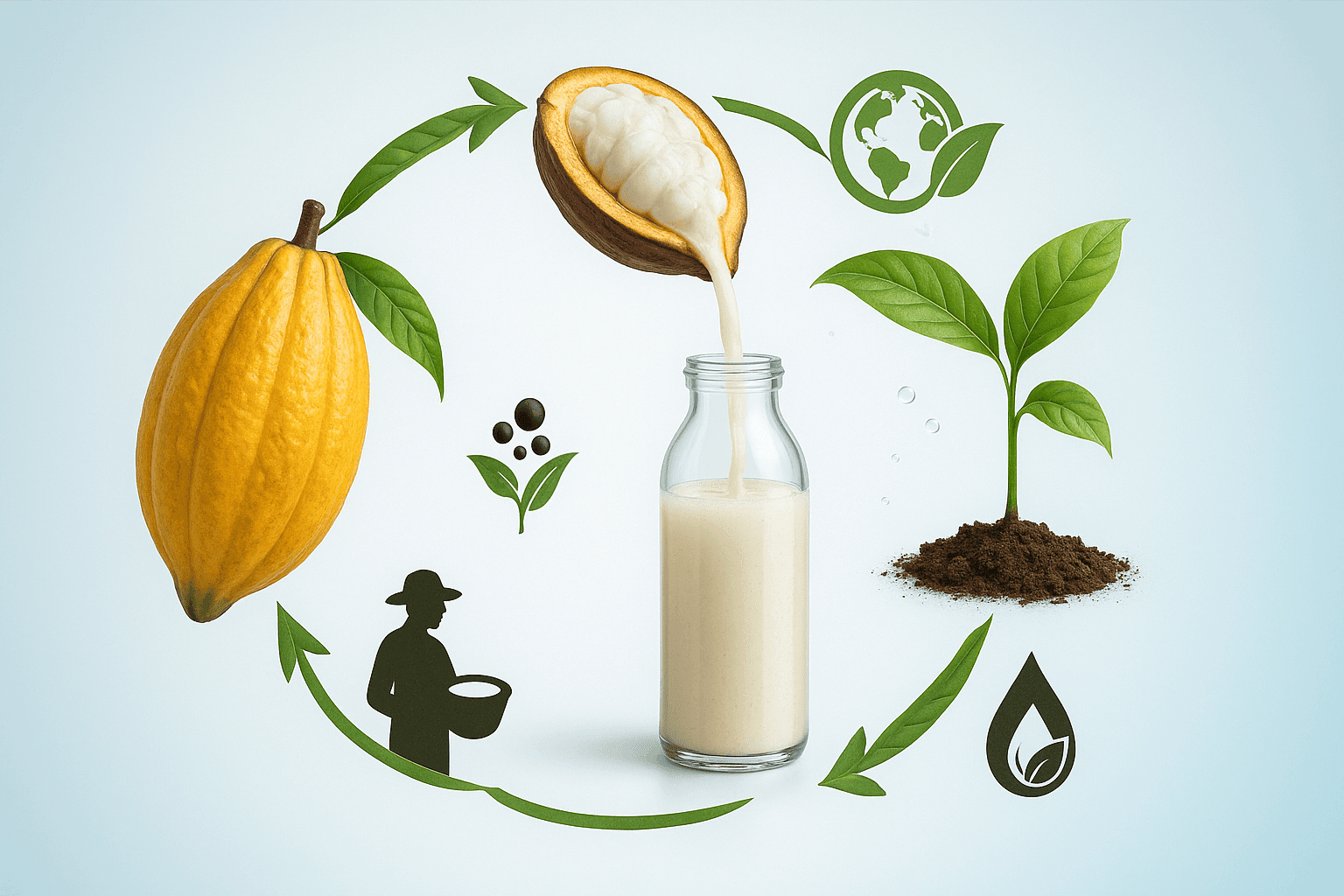
From Waste to Wellness: The Environmental Impact of Cacao Mucilage Utilization
The Hidden Environmental Crisis in Chocolate Production
Every year, the global chocolate industry generates 1.2 million tons of cacao mucilage waste—enough to fill 480 Olympic swimming pools. Until recently, this nutrient-rich liquid was simply discarded, contributing to water pollution and greenhouse gas emissions. Now, innovative valorization is transforming this waste stream into wellness products while creating a blueprint for sustainable agriculture.
The Scale of Waste: Understanding the Numbers
For every ton of dry cacao beans produced:
- 400 liters of mucilage are generated¹
- 70% traditionally goes to waste
- 280 liters could be recovered per ton
- $1,200 potential value lost per ton With global cacao production at 5.2 million tons annually², the opportunity is staggering:
- 2.08 billion liters of mucilage available
- 1.46 billion liters currently wasted
- $6.24 billion potential market value
- 150,000 tons CO₂ emissions preventable
Environmental Impact: A Life Cycle Assessment
Current Waste Disposal Methods and Their Consequences
Traditional mucilage disposal creates multiple environmental challenges:
Water Pollution
- BOD levels: 20,000-35,000 mg/L (100x higher than sewage)³
- Eutrophication: Excess nutrients trigger algae blooms
- Acidification: pH drops harm aquatic ecosystems
- Groundwater contamination: Seepage affects drinking water
Greenhouse Gas Emissions
When mucilage decomposes anaerobically:
- Produces methane (25x more potent than CO₂)
- Releases nitrous oxide (298x more potent than CO₂)
- Contributes 0.5 kg CO₂-eq per liter wasted⁴
Land Degradation
- Soil acidification from runoff
- Reduced biodiversity around processing sites
- Vector breeding grounds for disease
The Circular Economy Solution
From Linear to Circular: A Systems Approach
Traditional Linear Model: Cacao Pods → Beans (10%) → Chocolate ↓ Waste (90%) → Environmental Damage Circular Economy Model: Cacao Pods → Beans (10%) → Chocolate ↓ Mucilage (40%) → Wellness Products → Revenue ↓ Husks (50%) → Compost/Biochar → Soil Enhancement This transformation achieves:
- 70% waste reduction in cacao processing
- Zero waste potential with full valorization
- Carbon negative production cycle
- Regenerative agriculture support
Economic Impact: Farmer Livelihoods
The 30% Income Increase That Changes Everything
For a typical smallholder farmer producing 500kg cacao beans annually: Traditional Income:
- Beans: 500kg × $2.50/kg = $1,250/year With Mucilage Valorization:
- Beans: $1,250
- Mucilage: 200L × $2/L = $400
- Total: $1,650 (32% increase) This additional income enables:
- Children's education funding
- Healthcare access
- Farm improvements
- Climate resilience investments
Supporting 150+ Farming Families: A Case Study
In Colombia's cacao-growing regions, mucilage valorization has:
- Created 450 direct jobs
- Generated $2.1 million additional annual revenue
- Funded 87 educational scholarships
- Enabled 23 organic certifications
Resource Efficiency: The Numbers That Matter
Water Conservation
Traditional beverage crops vs. cacao mucilage: | Crop | Water Required | Land Use | Time to Harvest | | | Coconut Water | 2,500 L/kg | New plantations | 3-5 years | | Pomegranate | 3,200 L/kg | Dedicated orchards | 2-3 years | | Cacao Mucilage | 0 L/kg | No additional | Immediate |
Energy Savings
- No irrigation required (byproduct)
- No fertilizer for separate crop
- No pesticides needed
- Minimal processing energy
Land Preservation
By utilizing existing cacao farms:
- Zero deforestation required
- Biodiversity preservation
- Habitat protection
- Soil health maintenance
Carbon Footprint Analysis
Emissions Prevented
Per 1,000 liters of mucilage valorized:
- 500 kg CO₂-eq avoided from decomposition
- 200 kg CO₂-eq saved vs. alternative crops
- 50 kg CO₂-eq sequestered in improved soil
- Net: -750 kg CO₂-eq (carbon negative)
Comparison with Other Beverages
Carbon footprint per liter:
- Orange juice: 0.7 kg CO₂-eq
- Coconut water: 0.5 kg CO₂-eq
- Pomegranate juice: 0.9 kg CO₂-eq
- Cacao mucilage: -0.75 kg CO₂-eq
Biodiversity Benefits
Ecosystem Services Enhanced
Cacao agroforestry systems with mucilage valorization:
- Support 197 bird species⁵
- Host 26 mammal species
- Maintain 60% forest canopy cover
- Preserve pollinator populations
Reduced Chemical Inputs
Natural preservation through organic acids eliminates need for:
- Synthetic preservatives
- Chemical stabilizers
- Artificial colors
- Flavor enhancers
Social Impact: Community Development
Women's Empowerment
Mucilage processing creates opportunities for:
- Female-led cooperatives
- Value-addition activities
- Financial independence
- Leadership roles
Youth Engagement
New economic opportunities reduce:
- Urban migration by 40%
- Agricultural abandonment
- Generational poverty
- Social inequality
Regulatory Support and Recognition
International Frameworks Alignment
Mucilage valorization supports:
- UN SDG 12: Responsible consumption and production
- UN SDG 13: Climate action
- UN SDG 15: Life on land
- Paris Agreement: Emission reduction targets
Certifications and Standards
Projects have achieved:
- Rainforest Alliance certification
- Fair Trade premiums
- Organic standards
- Carbon credits eligibility
The Ripple Effect: Industry Transformation
Inspiring Change Across Sectors
The success of cacao mucilage valorization has prompted:
- Coffee: Cascara and mucilage utilization
- Citrus: Peel and pulp valorization
- Mango: Kernel and peel processing
- Pineapple: Core and crown utilization
Investment and Innovation
- $45 million invested in processing infrastructure
- 12 patents filed for extraction methods
- 8 universities conducting research
- 23 startups launched globally
Future Projections: 2025-2030
Market Growth
- Projected $2.3 billion market by 2030
- 35% CAGR expected growth
- 47 countries adopting valorization
- 500,000 farmers benefiting
Environmental Goals
- 3.5 million tons CO₂ prevented annually
- 85% waste reduction in cacao sector
- 2 million hectares preserved
- 15% reduction in water pollution
Call to Action: Join the Movement
For Businesses
- Source products supporting valorization
- Invest in processing infrastructure
- Share the sustainability story
- Measure and report impact
For Consumers
- Choose brands using cacao mucilage
- Support circular economy products
- Advocate for waste reduction
- Share knowledge with others
References
¹ Anvoh, K.Y.B., et al. (2009). "Production and characterization of juice from cacao pulp." Food Chemistry, 112(4), 906-911. ² International Cocoa Organization (2023). "Quarterly Bulletin of Cocoa Statistics, Vol. XLIX, No. 4." ³ Panak Balentić, J., et al. (2018). "Cocoa shell: A by-product with great potential for wide application." Molecules, 23(6), 1404. ⁴ Okiyama, D.C., et al. (2017). "Cocoa shell and its compounds: Applications in the food industry." Trends in Food Science & Technology, 63, 103-112. ⁵ Rice, R.A., & Greenberg, R. (2000). "Cacao cultivation and the conservation of biological diversity." AMBIO, 29(3), 167-173. Discover more about our commitment to sustainability in our research library or learn about the nutritional benefits of this revolutionary approach to waste valorization.
Learn More About Cacao Mucilage
- Complete Nutritional Profile - Discover the antioxidants and compounds
- Science-Backed Health Benefits - Research on cardiovascular and cognitive effects
- Sustainability Impact - How mucilage reduces waste and increases farmer income
- Commercial Applications - How the industry uses cacao mucilage
Ready to Source Premium Cacao Mucilage?
October 2025 harvest allocations available. Territory exclusivity for qualified partners.