
What Is in Cacao Mucilage Juice: The Measured Values
A plain summary of what GRAS Notice 947 measured in commercial cacao fruit juice, from sugars and minerals to acidity, with the source of every figure.
What Is in Cacao Mucilage Juice: The Measured Values
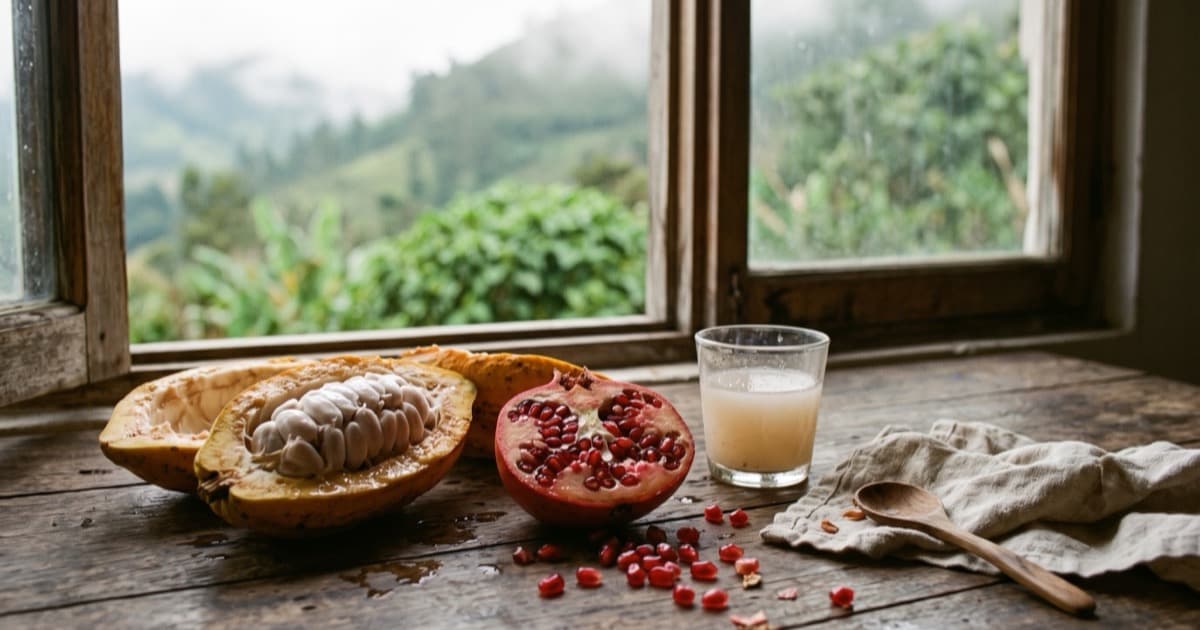
Cacao mucilage is the white, translucent pulp that surrounds the beans inside a cacao pod. Pressed into juice, it tastes of lychee and citrus, not of chocolate. This article lists what has been measured in it and where each number comes from. Where nothing has been measured, we say nothing.
Where the numbers come from
Most figures below come from GRAS Notice 947, a notice that CABOSSE Naturals NV submitted to the U.S. FDA in June 2020 for cacao pulp, cacao fruit juice and cacao fruit juice concentrate. The values are for the commercial cacao fruit juice, per 100 g, as the mean of five samples.
Energy and sugars
- Energy: 83 kcal.
- Carbohydrates: 19.5 g, of which total sugars are 18.0 g.
- Protein: 0.6 g.
- Fat: below 0.2 g.
- Dietary fiber: 0.8 g.
Minerals and vitamins
- Potassium: 202 mg.
- Magnesium: 22 mg.
- Calcium: 7.3 mg.
- Sodium: 1 mg.
- Vitamin C: below the limit of quantification (0.5 mg).
The notice describes the vitamin content of cacao pulp products as low.
Polyphenols
Total polyphenols in the juice, measured as gallic acid equivalents, averaged 61.9 mg per 100 g. The same notice reports 106.5 mg for the pulp and 160.4 mg for the juice concentrate.
A separate study, Llerena et al. (2023), measured mucilage collected from fermenting cocoa beans in Ecuador and reported 105.08 mg per 100 mL. That is a different kind of sample, so the two numbers describe different materials. For the commercial juice we use the notice's figure.
Acidity
The pH of the pulp and juice in the notice is 3.0 to 3.3. Citric acid is the main organic acid, at about 1.0 g per 100 g, and it gives the juice its tart edge.
What this article leaves out
We do not set this juice against other foods or drinks, and we do not describe any effect on the body. The sources measured composition, and that is all we report. For serving suggestions and cautions, see the safety information.
Sources
- Llerena, W., et al. (2023). Profile of Bioactive Components of Cocoa (Theobroma cacao L.) By-Products from Ecuador and Evaluation of Their Antioxidant Activity. Foods, 12(13), 2583. https://doi.org/10.3390/foods12132583.
- CABOSSE Naturals NV (notifier). GRAS Notice GRN 947: Cacao pulp, cacao fruit juice, and cacao fruit juice concentrate (FDA response: no questions). U.S. FDA GRAS Notice Inventory, 2020. Notice (PDF) (opens in a new tab).
Learn more
- What the studies report - What published studies and GRAS Notice 947 report
- Regulatory status - How cacao pulp and juice are treated in the United States, the European Union and Brazil
- Safety information - Serving suggestions and cautions
- Nutrition facts and sources - The measured values and where each comes from
This content is for educational purposes only and summarizes published sources. It is not medical advice.